Born too soon
November 15, 2026
Protecting the lives of pregnant women and their babies, one package of care at a time.
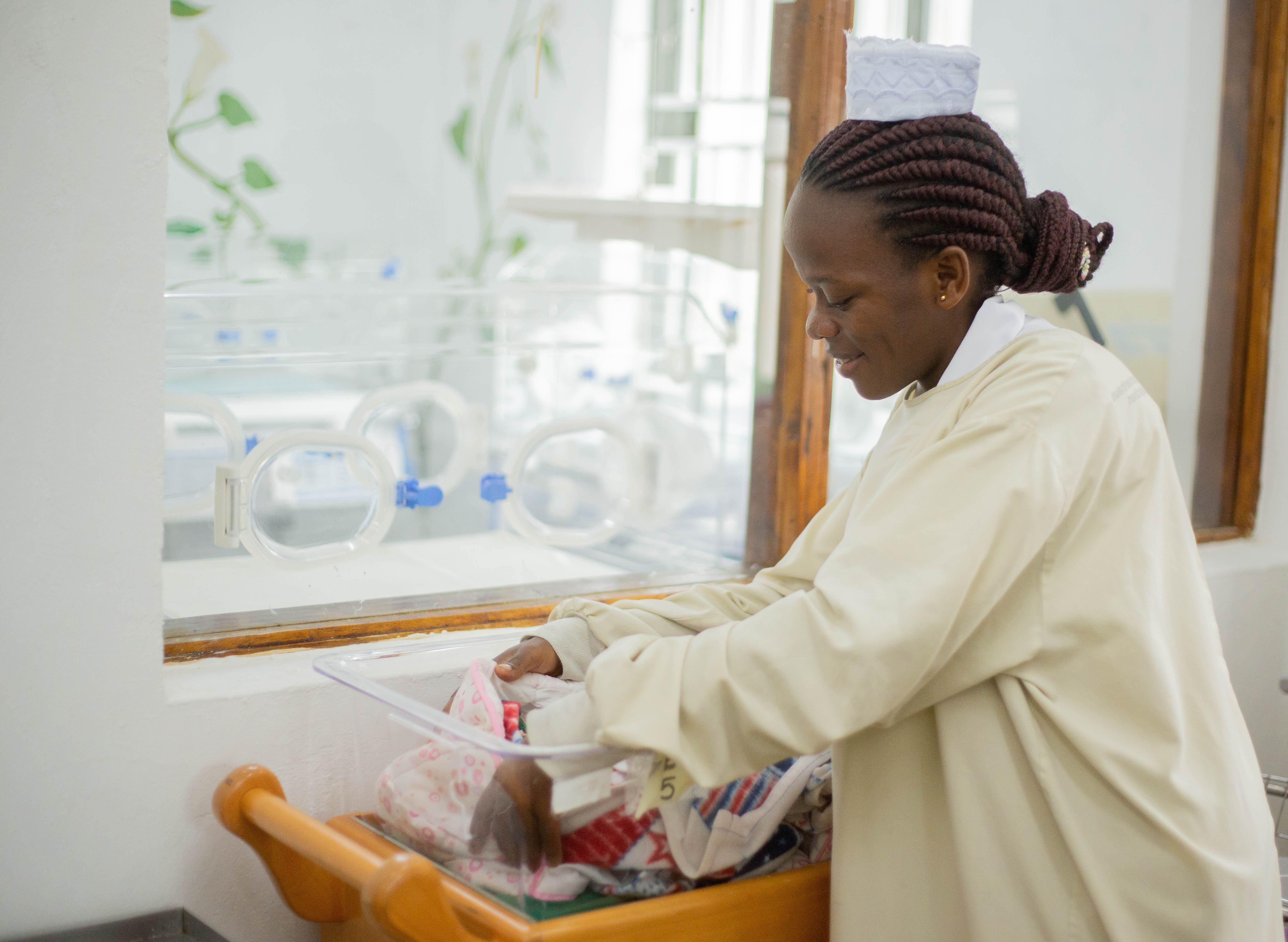
Monica Rasubi went to antenatal care four times during her pregnancy. Her blood pressure was checked once. Her haemoglobin was never tested. She gave birth at Kwitanda Health Facility in Balaka, Malawi, at 34 weeks, to a baby weighing 2 kilograms.
Truth Sankhani, the nurse-midwife who cares for her, cannot say for certain what brought the birth on early. Kwitanda lacks urine dipsticks, blood pressure machines and haemoglobin testing equipment, so the checks that might have revealed pre-eclampsia or anaemia were not possible before the birth or after it. For now, Monica is practising kangaroo mother care with Truth’s guidance, holding her baby skin-to-skin to keep the baby warm and support their growth.
Truth has seen how these gaps end. The facility handles around 30 deliveries a month, and in her year and a half there, she has met several women with pre-eclampsia and anaemia. One case stays with her. She referred a pregnant woman with pre-eclampsia to Balaka District Hospital, where the woman gave birth at 35 weeks. The baby was born alive but died shortly afterwards.
“Having the necessary diagnostic supplies would make a huge difference. We would be able to identify and manage some of these complications right here at the facility.” Truth Sankhani, nurse-midwife, Kwitanda Health Facility, Balaka, Malawi
Monica’s experience is far from rare. WHO estimates that 13.4 million babies were born preterm in 2020, before 37 completed weeks, around one in ten births worldwide. Not every early birth starts with labour coming too soon. Sometimes a complication in pregnancy makes early delivery the safest option for the mother, the baby or both.
Pre-eclampsia is one of the most important of these complications. It is a high blood pressure disorder that usually develops after 20 weeks of pregnancy and affects between 3 and 8 per cent of women who give birth worldwide. It can disrupt how the placenta works, reducing the oxygen and nutrients that reach the baby and restricting growth. When it becomes severe, health workers may recommend induction or a caesarean birth before 37 weeks because continuing the pregnancy would be more dangerous.
Anaemia adds a second risk. Haemoglobin carries oxygen from the mother to the placenta and the baby, so when it is low, less oxygen gets through. A 2023 global review of 148 studies found that low maternal haemoglobin was associated with 35 per cent higher odds of preterm birth. That does not mean anaemia causes every early birth, but the link is significant, and it is one more reason a blood pressure check and a haemoglobin test belong in every antenatal visit. They are the checks Monica did not receive.
Where the system breaks down
The products to prevent and treat both conditions already exist and the evidence for them is settled. The weak point is the system meant to deliver them. Across Ghana, Kenya, Malawi and Tanzania, it breaks down at several connected points.
It starts with policy. National essential medicines lists have not caught up with the evidence. Low-dose aspirin is often listed only as an antiplatelet, calcium has no antenatal indication, and intravenous ferric carboxymaltose (FCM) and multiple micronutrient supplements (MMS) are missing from most lists, so facilities cannot order or budget for them even where guidelines recommend their use. In most of the four countries, calcium gluconate, the antidote to magnesium sulphate toxicity, is listed for a higher level of care than magnesium sulphate itself. Lower-level facilities can give the treatment but have no means to reverse it.
Those gaps carry through to the shelf. Magnesium sulphate is widely stocked but less reliably found at the dispensaries and health centres that should give the first dose, and the antidote is missing far more often. Injectable antihypertensives such as labetalol often run out at the hospitals expected to stock them. In Malawi, foreign exchange shortages limit what the central medical stores can buy, and the calcium tablet in public supply cannot deliver the dose needed for prevention. Patchy haemoglobin testing and a shortage of large blood pressure cuffs mean anaemia and high blood pressure can go unnoticed until a woman arrives in labour, as Truth sees at Kwitanda.
When stock runs out, most clinicians send women to buy the product privately, and hospitals often charge for items that are meant to be free. Health insurance offers uneven protection because schemes pay late, reimburse less than it costs to replace stock or cover only part of the population, so an insured woman may still pay at the point of care. Health workers face a gap of their own: their confidence in starting magnesium sulphate runs ahead of their knowledge of the correct loading dose and the first signs of toxicity.
Each gap feeds the next. A product left off the essential medicines list is not procured centrally, never reaches the facility and becomes a private purchase many women cannot afford. Because aspirin and calcium lower the risk of pre-eclampsia, and anaemia is itself linked to preterm birth, every missing product makes an early birth more likely. For a woman who reaches care late with severe pre-eclampsia or anaemia, that delay can decide whether she and her baby survive.
How SUPREME is closing the gap
SUPREME Lifelines was set up to close these gaps. It is one of two consortia under the Sustained Uptake of Products for Pre-Eclampsia and Maternal Anaemia (SUPREME) initiative, funded by Unitaid. Amref Health Africa leads SUPREME Lifelines with Jhpiego, Solthis and Market Access Africa in Ghana, Kenya, Malawi, Senegal and Tanzania. Its sister consortium, SUPREME SECURE, led by the Clinton Health Access Initiative (CHAI), works with manufacturers and suppliers to improve access to quality products and develop new ones. SUPREME Lifelines focuses on getting those products into routine care and into women’s hands.
In each country, the project works with the Ministry of Health, health workers, women and communities to design a package of care for pre-eclampsia and anaemia. It brings calcium, low-dose aspirin, blood pressure monitors, haemoglobinometers and multiple micronutrient supplements into antenatal and delivery care through models that give women more time and support: group antenatal care, midwifery-led care and networks of care that link health centres to hospitals. Implementation research at project sites will show whether these packages work in real clinics, whether women and health workers accept them and what they cost.
The barriers described above come from the project’s market assessment, led by Market Access Africa, and they now shape product-by-product roadmaps on listing, registration, procurement and financing with each government. Community and civil society organisations are helping women understand what good antenatal care looks like and encouraging them to start it early.
Governments do not need to wait for new products to act. Ministries of Health can list low-dose aspirin, calcium, multiple micronutrient supplements and intravenous iron for use in pregnancy, and make calcium gluconate available wherever magnesium sulphate is given. They can fund these products through national procurement, ensure insurance schemes pay on time and at the real cost, and keep blood pressure cuffs, urine dipsticks and haemoglobin tests in every facility that offers antenatal care.
For Truth, the change she wants is practical. When the next pregnant woman walks into Kwitanda, she wants to check her blood pressure and haemoglobin there and then, and act on what she finds, long before a baby needs to arrive early.
Written by:
Paullette Adhiambo, Communications Associate, Amref Health Africa
Dr. Lynn Kanyuuru, Principal, MNCH Programs
Lusayo Banda, Communications Manager, Amref Health Africa in Malawi
David Mitine, Communications Manager, Amref Health Africa